
About Collaborative Divorce

Divorce doesn't have to be war!
Are you wanting a different divorce experience for you and your loved ones? Collaborative divorce might be the answer.
Everyone knows someone who has been divorced. You may have been a child of divorce or have been divorced yourself. For many families, it is a difficult process that can be attached to many negative memories and emotions. It doesn't have to be that way!
Collaborative divorce is an established divorce process that can help lower conflict, create a good co-parenting relationship, and save money. Collaborative divorce focuses on resolving issues through cooperation and good faith negotiation rather than litigation and confrontation.
Collaborative is different because each professional is trained in the process and, importantly, trained in helping people talk things through. Depending on the case, a mental-health trained Family Transition Specialist, Financial Neutral, or other professional can be brought onto the team with the clients and Collaborative attorneys so that the issues are handled holistically. This can be cheaper and more straightforward than each person hiring, consulting with and bringing competing specialists to testify at trial.
A Collaborative divorce aims to provide a resolution based on each person's individual needs and interests, so that things get resolved in the most optimal way possible. Each Collaborative divorce will look different. You can get connected with a Collaborative attorney or Family Transitions Specialist to learn more.
What is Collaborative Law?
Collaborative Law is an established method of resolving disputes. Its primary use is in family law, but it can be used to resolve disputes involving business, employment, probate, real estate, and other civil law matters. Collaborative law has a simple premise of four key elements:
- Voluntary, open and free exchange of information.
- Pledge not to go to court (litigate).
- The professionals’ commitment to assist you in reaching agreement.
- A commitment to work respectfully together in good faith towards a mutually acceptable solution.

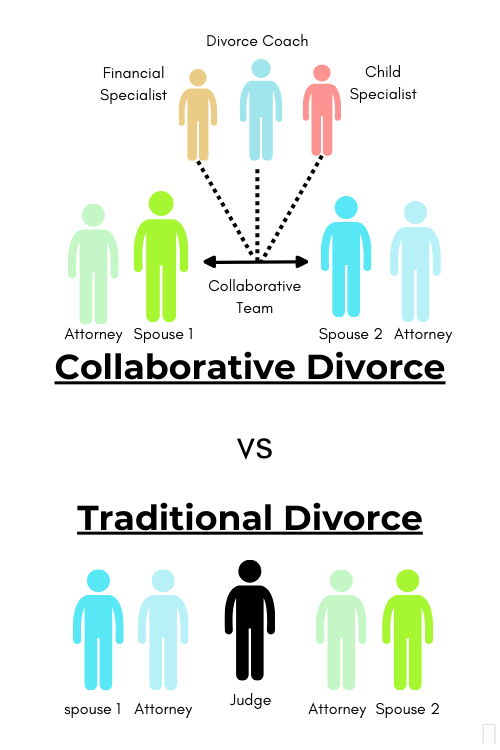
Who might be on my collaborative team?
In a Collaborative divorce, each person hires their own Collaborative attorney who is trained in Collaborative law. The participants sign an agreement stating their commitment to resolve the issues outside of court, provide information openly, and work in good faith towards settlement. The process involves a series of meetings, where the team comes together to discuss and negotiate various aspects of the divorce, such as property division, child custody, and spousal support.
A Collaborative Divorce is custom tailored to suit your needs. A Collaborative team might include various professionals to help you make educated decisions based on your situation. Some of the optional professionals to consider are:
-
Family Transition Specialists (FTS)
A Family Transition Specialist (FTS) has a professional background in mental health, mediation and/or coaching. In a Collaborative Divorce, the FTS may facilitate Collaborative team meetings but most of their work is done directly with the separating couple. The FTS helps parties manage the emotional complexities of divorce and co-create family-related agreements. Depending on the unique needs of each family, the FTS might address communication skills and emotional management strategies, building a Collaborative Divorce professional team, establishing new boundaries, separating homes, regular and holiday parenting time agreements, or talking to children about divorce. For families with children, the FTS typically writes the court-required Parenting Plan Agreement. Enlisting the support of a Family Transition Specialist early on can ensure a smoother and more streamlined process. - Child SpecialistA Child Specialist is a licensed mental health professional trained in child development and whose expertise is working directly with children. In the Collaborative Divorce process, a Child Specialist brings forth children's voices; their concerns, hopes and unique view of what is happening in their family and how it impacts them. A Child Specialist typically meets a finite number of times with the child and also with the parents, either individually or jointly. Their insights can help parents understand how their children are experiencing the change in their family and how parents can support them through this transition.
-
Psychologists
Psychologists are licensed mental health professionals that hold a PhD or PsyD degree, which indicates their level of training and experience. In Collaborative Divorce, they can provide child assessments, child-parent assessments, and parenting evaluations to assist families in making decisions throughout the separation process. They can write formal or less formal reports with their assessment-based recommendations, depending on what clients need. Within the Collaborative process, their insights can help shape parenting plans and timelines with more specific professional recommendations. A psychologist may also act as a Family Transition Specialist or child specialist in Collaborative divorce cases. -
Mediators
A mediator in a Collaborative divorce helps to facilitate communication and negotiation between both parties to help them reach a mutually agreeable solution. Unlike a traditional litigator, the mediator remains neutral and does not make decisions for the parties. Instead, they guide discussions, clarify misunderstandings, and help identify common ground on key issues like asset division, child custody, and spousal support. The goal of the mediator is to promote cooperation, reduce conflict, and assist in creating a fair, amicable resolution that works for both individuals and their family. - Certified Divorce Financial Analysts (CDFA)
In a Collaborative Divorce, a Certified Divorce Financial Analyst helps both parties understand the financial implications of their decisions. They provide expertise in dividing assets, assessing tax consequences, and projecting future financial outcomes to ensure equitable settlement. The CDFA helps clients make informed decisions about spousal support, retirement plans, and budgeting for post-divorce life, supporting parties in making financial choices are aligned with each party's long-term goals and well-being. Their role is crucial in creating fair and sustainable financial arrangements for both spouses. -
Home & Lending Professionals
A home and lending professional in a Collaborative divorce helps both parties navigate real estate and mortgage-related decisions. They provide advice on the division of the family home, assess the feasibility of refinancing or selling, and guide clients through mortgage options. By evaluating the financial implications of retaining or selling property, as well as helping secure financing if needed, they support both parties in making informed decisions that support long-term financial stability for both sides. Their role is essential in addressing housing needs and facilitating a smooth transition during and after the divorce.
What are the benefits of collaborative divorce?
-
Cooperation
Collaborative divorce encourages open and respectful communication between partners, promoting a more amicable and less confrontational approach. Collaborative negotiation requires a good faith effort to resolve each issue to everyone's satisfaction and can take each person's needs and interests into account. -
Control
The couple has more control over the outcome of their divorce since they actively participate in the decision-making process, rather than having a judge make those decisions. -
Privacy
Collaborative divorce proceedings are generally confidential and take place outside of the public court system (with only the final documents reflecting the agreements filed in court, rather than the individual motions and interim orders). -
Cost-Effectiveness
Collaborative divorce may be less expensive than a lengthy court process, as it generally requires no court appearances. The total cost depends on how quickly the couple reaches an agreement, and how much work the professionals need to do.


Is collaborative practice suitable for all couples?
Collaborative Divorce might be an option when:
- Everyone understands that divorce isn’t easy but want make the transition as easy as possible.
- Everyone is willing to deal with difficult issues (in a supported way), rather than having attorney deal with them.
- Everyone is able to engage respectfully in seeking to resolve the issues.
Collaborative Divorce might NOT be an option when:
- It's not possible to be in the same room (or virtual room) with one another.
- A client wants their attorney to address all difficult issues so they don’t have to.
- Active domestic violence is present, or there is a history of abuse, domestic violence, restraining orders or major power imbalances in the relationship.
There are serious substance abuse or mental health issues can also make other options more appropriate. Depending on the circumstances, however, Family Transitions Specialists can help make participation possible.
how do i start building my collaborative team?